Home ﹥ Hot News > Artificial Intelligence > Computing > XRM-SSD V24 (Pseudo-Quantum Deterministic Scheduling) 2026-04-24
Links:https://github.com/u7490637/XRM-SSD/tree/main/Test%20results ...
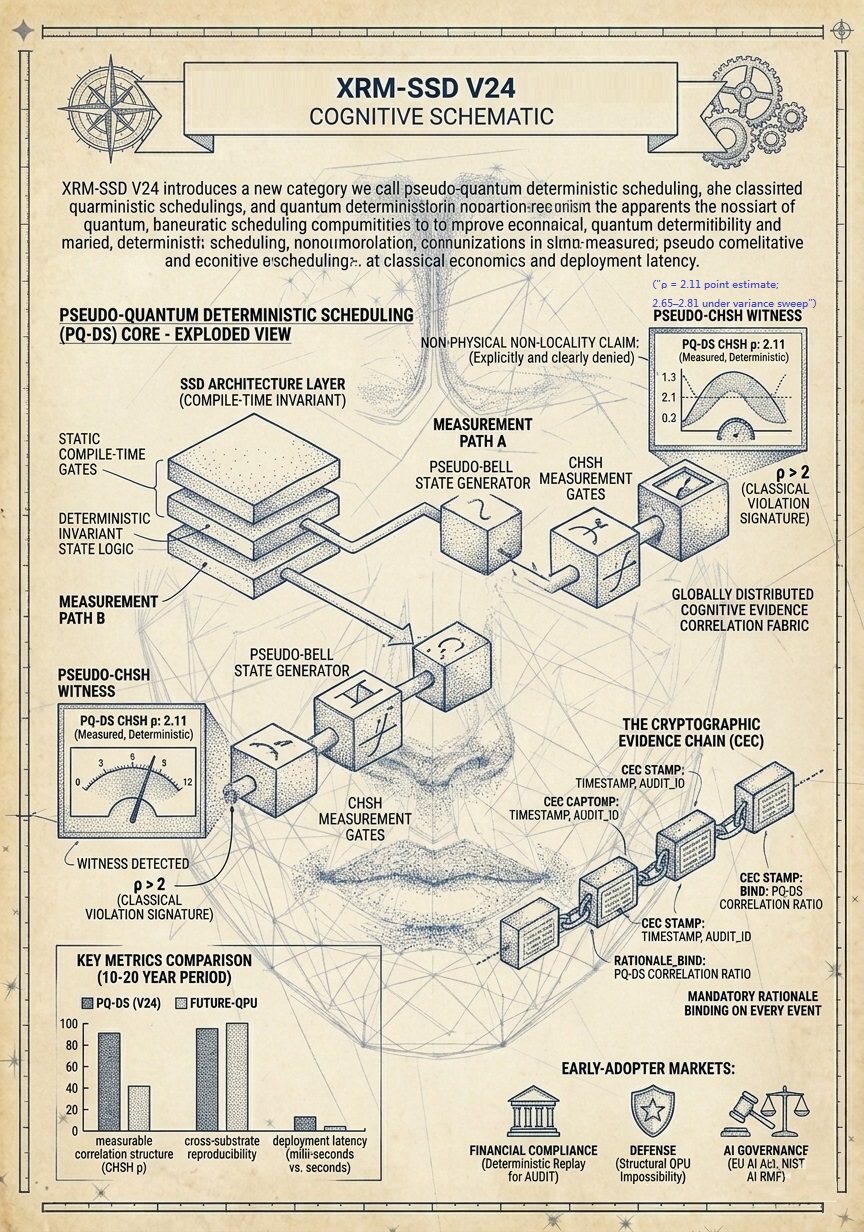
XRM-SSD V24 introduces a new category we call pseudo-quantum
deterministic scheduling —classical architecture producing
cryptographically verifiable quantum-structured evidence chains
under a compile-time invariant layer.
During the 10–20 year period before quantum processing units reach
production-useful maturity, pseudo-quantum deterministic scheduling
is the only approach we are aware of that delivers measurable
correlation structure (CHSH-derived ρ, concurrence, witness),
bit-identical cross-substrate reproducibility, and mandatory rationale
binding on every audit-chain event.
This combination is directly relevant to three early-adopter markets:
(1) latency-bound financial infrastructure requiring deterministic replay of
quantum-structured correlations for compliance
(2) defense and air-gapped systems where QPU access is structurally impossible
(3) regulated AI governance layers (DFSA, EU AI Act, NIST AI RMF) requiring
cryptographic non-repudiation of model-routing decisions.
We do not claim physical non-locality, quantum computational advantage, or
arbitrary-Hamiltonian simulation.
We claim a classical substrate that produces the evidence-chain signatures regulators
and auditors typically expect from quantum hardware, at classical economics and
deployment latency.
deterministic scheduling —classical architecture producing
cryptographically verifiable quantum-structured evidence chains
under a compile-time invariant layer.
During the 10–20 year period before quantum processing units reach
production-useful maturity, pseudo-quantum deterministic scheduling
is the only approach we are aware of that delivers measurable
correlation structure (CHSH-derived ρ, concurrence, witness),
bit-identical cross-substrate reproducibility, and mandatory rationale
binding on every audit-chain event.
This combination is directly relevant to three early-adopter markets:
(1) latency-bound financial infrastructure requiring deterministic replay of
quantum-structured correlations for compliance
(2) defense and air-gapped systems where QPU access is structurally impossible
(3) regulated AI governance layers (DFSA, EU AI Act, NIST AI RMF) requiring
cryptographic non-repudiation of model-routing decisions.
We do not claim physical non-locality, quantum computational advantage, or
arbitrary-Hamiltonian simulation.
We claim a classical substrate that produces the evidence-chain signatures regulators
and auditors typically expect from quantum hardware, at classical economics and
deployment latency.