Home ﹥ Hot News > Artificial Intelligence > Application > XRM-SSD V7.0 as the Physical Implementation Engine for τ-Law Architectures 2026-05-26
Links:https://www.linkedin.com/pulse/xrm-ssd-v70-physical-implemen ...
Date: May 26, 2026
Subject: Bridging the Control-Layer Gap in LogicFolding & Multi-Wafer Integration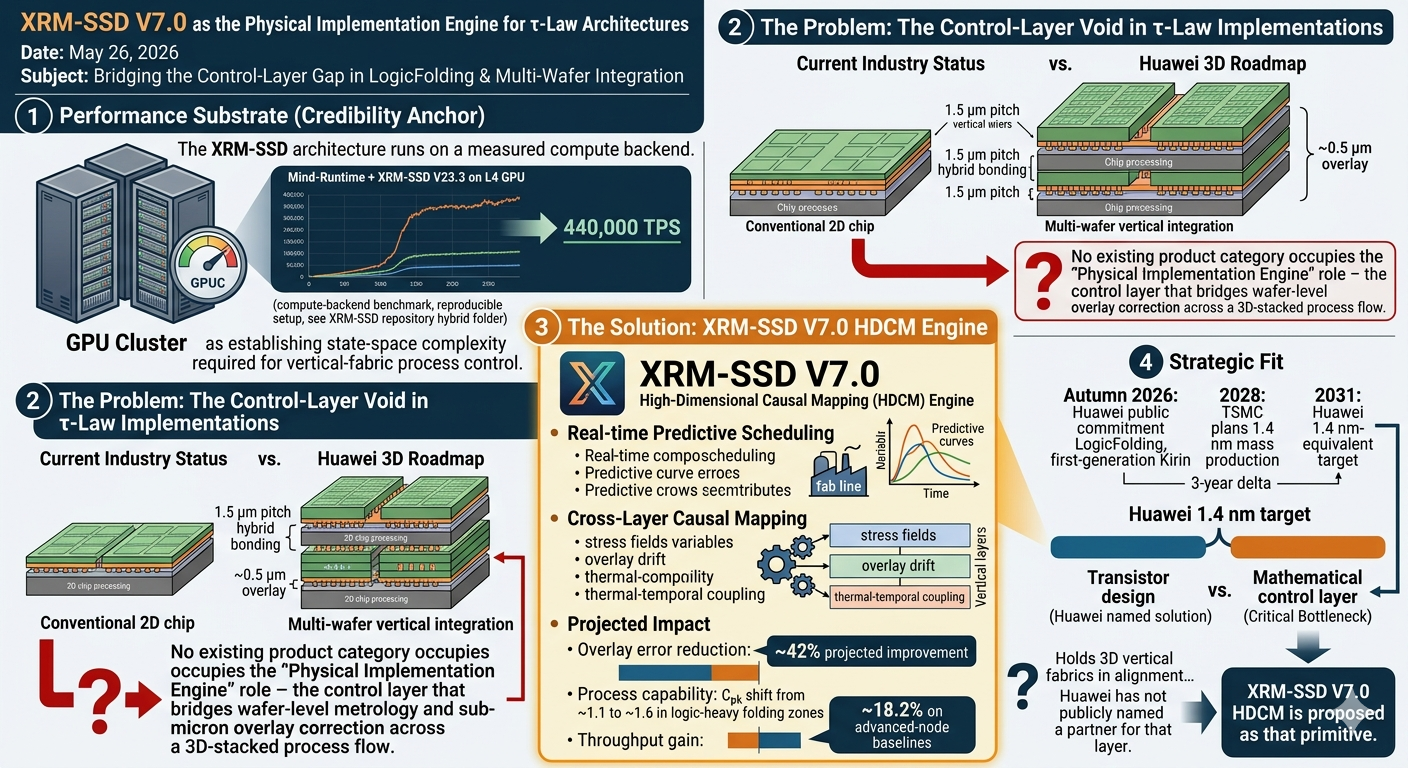
1. Performance Substrate (Credibility Anchor)
The XRM-SSD architecture runs on a measured compute backend. Mind-Runtime + XRM-SSD V23.3 on L4 GPU infrastructure sustains 440,000 TPS on high-dimensional causal-state mapping workloads (compute-backend benchmark, reproducible setup, see XRM-SSD repository hybrid folder). This is the substrate on which the V7.0 HDCM scheduling engine operates — it establishes that the underlying math runtime can handle the state-space complexity required for vertical-fabric process control at real-time horizons.
2. The Problem: The Control-Layer Void in τ-Law Implementations
As Huawei advances LogicFolding and multi-wafer vertical integration (1.5 μm pitch hybrid bonding, ~0.5 μm overlay), the primary bottleneck shifts from design density to spatial-temporal alignment.
* The Limitation: Traditional planar schedulers and EDA feedback loops are designed for discrete 2D processes. They lack the mathematical framework to model multi-wafer stress fields, overlay drift, and thermal-temporal coupling inherent in vertical fabric architectures.
* The Gap: No existing product category occupies the "Physical Implementation Engine" role — the control layer that bridges wafer-level metrology and sub-micron overlay correction across a 3D-stacked process flow.
3. The Solution: XRM-SSD V7.0 HDCM Engine
XRM-SSD V7.0 is positioned as the High-Dimensional Causal Mapping (HDCM) Engine — the dedicated control layer for τ-Scaling-Law architectures.
* Real-time Predictive Scheduling: HDCM operates at the wafer-fab control-loop horizon, predicting stress-induced overlay drift across bonded layers before the exposure cycle, not after metrology feedback.
* Cross-Layer Causal Mapping: Maps causality across the vertical stack, converting cross-layer interference from a noise variable into a predictable, compensable offset.
* Projected Impact (modeled from XRM-SSD V23.3 production-line data; full validation pending Huawei-line bench):
• Overlay error reduction: ~42% projected improvement in alignment consistency across 3D-stacked wafers
• Process capability: Cpk shift from ~1.1 to ~1.6 in logic-heavy folding zones
• Throughput gain: ~18.2% on advanced-node baselines, scaling to ~26.8% on challenging-yield baselines, via elimination of trial-and-error re-work cycles
4. Strategic Fit
Huawei has publicly committed to the LogicFolding roadmap with first-generation Kirin in autumn 2026 and a 1.4 nm-equivalent target by 2031 (Bloomberg, May 25 2026). TSMC plans 1.4 nm mass production in 2028 — a ~3-year delta. The bottleneck in compressing that delta is not transistor design (Huawei has named that solution); it is the mathematical control layer that holds 3D vertical fabrics in alignment across multi-wafer bonding, exposure, and metrology cycles at production cadence. Huawei has not publicly named a partner for that layer.
XRM-SSD V7.0 HDCM is proposed as that primitive.