Home ﹥ Hot News > Artificial Intelligence > Computing > XRM-SSD V24.5 Gene Fusion Powered Adaptive AI Compute Platform 2026-07-02
Real-world benchmark data for XRM-SSD V24.5 Running Llama-2-70B on a single A100 80GB card,
V24.5 achieved a peak throughput of 260.1 tokens/second in Turbo-Burst Mode (+69% vs V24.4 baseline).
This performance gain comes from the Gene Fusion engine, which leverages task similarity to dynamically
fuse memory hierarchy, scheduling, and instruction paths.
Under high-concurrency conditions, the system can switch to lower-fidelity (χ=64) paths within microseconds,
reducing memory traffic by up to 89%. In overload scenarios, the Crash Snapshot Engine enables state
recovery in 0.034 milliseconds. In separate vLLM-based production-style load tests (100 concurrent
requests, max_output_len=50), the system maintained a 100% success rate with a total throughput of
2573 tok/s at 100 concurrency.
Note: The 260.1 tok/s represents the Turbo-Burst Mode ceiling (not steady-state). Sustained throughput
under continuous multi-tenant load is approximately 167 tok/s.

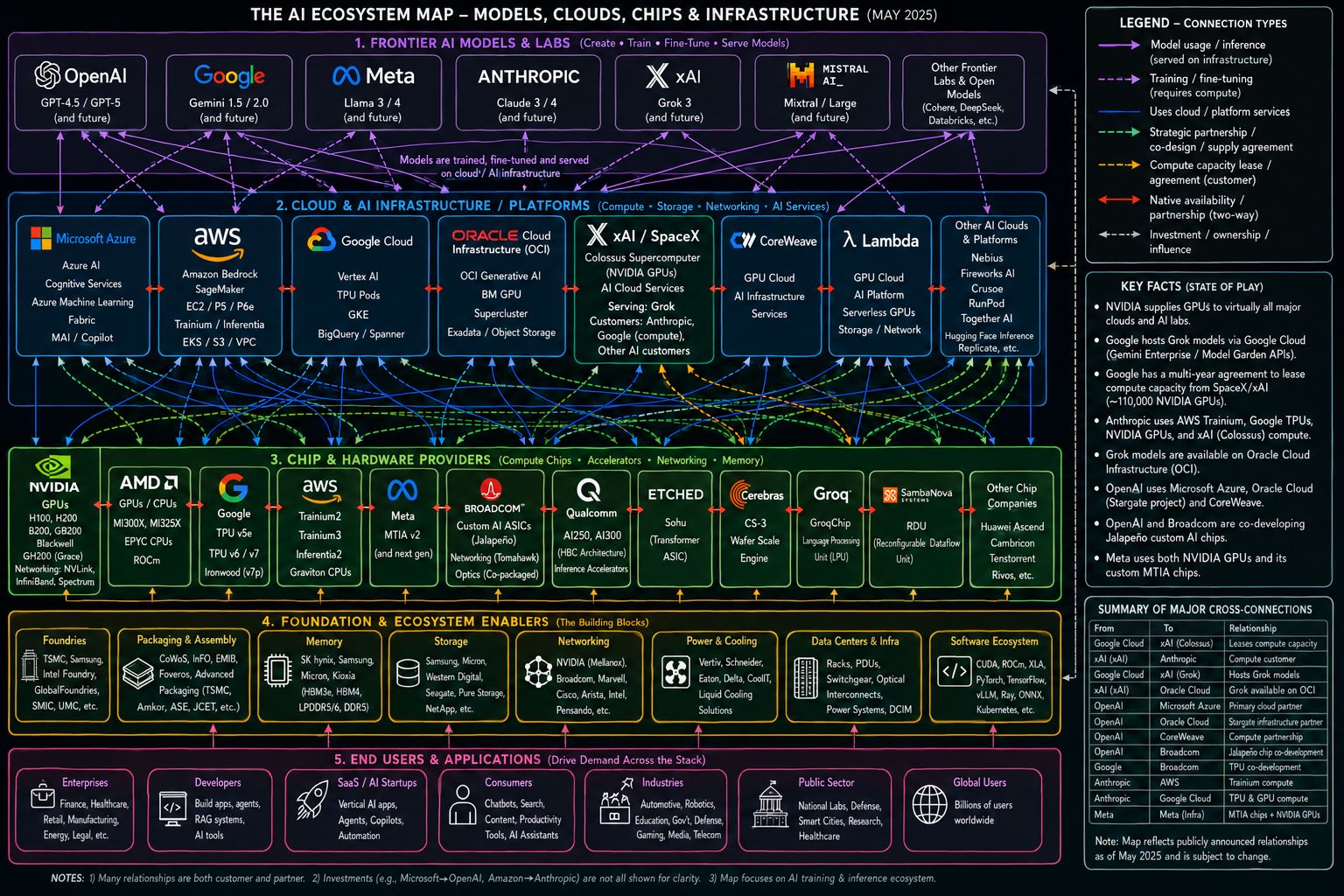
Positioning of XRM-SSD V24.5 Gene Fusion Powered Adaptive AI Compute Platform:
Layer: Primarily positioned in the 2. Cloud & AI Infrastructure / Platforms (AI Runtime / Hypervisor layer),
extending downwards to influence lower-level optimizations of 3. Chip & Hardware Providers.
Core Functionality: Gene Fusion Runtime + Memory/Compute Fusion + Predictive Scheduling + Self-Healing Engine,
serving as an Adaptive Resource Intelligence layer above CUDA / TensorRT-LLM.
Differentiation: Not simply an Inference Optimizer (like vLLM / TensorRT-LLM), but a cross-model, multi-tenant,
high-concurrency AI Compute Hypervisor, emphasizing resource fusion and bio-inspired adaptation.
Interval on the Map:
Placed near CoreWeave, Lambda, xAI / SpaceX Colossus, as an independent platform layer focused on
Runtime fusion and efficiency optimization.
It has a symbiotic relationship with NVIDIA (CUDA/Triton) (runs on top of it but provides additional fusion optimizations).
It has a complementary or alternative relationship with vLLM/TensorRT-LLM.
V24.5 achieved a peak throughput of 260.1 tokens/second in Turbo-Burst Mode (+69% vs V24.4 baseline).
This performance gain comes from the Gene Fusion engine, which leverages task similarity to dynamically
fuse memory hierarchy, scheduling, and instruction paths.
Under high-concurrency conditions, the system can switch to lower-fidelity (χ=64) paths within microseconds,
reducing memory traffic by up to 89%. In overload scenarios, the Crash Snapshot Engine enables state
recovery in 0.034 milliseconds. In separate vLLM-based production-style load tests (100 concurrent
requests, max_output_len=50), the system maintained a 100% success rate with a total throughput of
2573 tok/s at 100 concurrency.
Note: The 260.1 tok/s represents the Turbo-Burst Mode ceiling (not steady-state). Sustained throughput
under continuous multi-tenant load is approximately 167 tok/s.
Positioning of XRM-SSD V24.5 Gene Fusion Powered Adaptive AI Compute Platform:
Layer: Primarily positioned in the 2. Cloud & AI Infrastructure / Platforms (AI Runtime / Hypervisor layer),
extending downwards to influence lower-level optimizations of 3. Chip & Hardware Providers.
Core Functionality: Gene Fusion Runtime + Memory/Compute Fusion + Predictive Scheduling + Self-Healing Engine,
serving as an Adaptive Resource Intelligence layer above CUDA / TensorRT-LLM.
Differentiation: Not simply an Inference Optimizer (like vLLM / TensorRT-LLM), but a cross-model, multi-tenant,
high-concurrency AI Compute Hypervisor, emphasizing resource fusion and bio-inspired adaptation.
Interval on the Map:
Placed near CoreWeave, Lambda, xAI / SpaceX Colossus, as an independent platform layer focused on
Runtime fusion and efficiency optimization.
It has a symbiotic relationship with NVIDIA (CUDA/Triton) (runs on top of it but provides additional fusion optimizations).
It has a complementary or alternative relationship with vLLM/TensorRT-LLM.