Home
1
Hot News
2
Computing
3
XRM-SSD-V3.1.3 simulating Perplexity AI 20254
https://www.dollarchip.com.tw/ Dollarchip Technology Inc.
Dollarchip Technology Inc. 台北市中山區松江路289號4樓-6
A Unified Cognitive Coordination Layer for Next-Generation AI SystemsAbstractAs artificial intelligence systems scale in complexity—integrating heterogeneous models, distributed compute, and dynamic memory layers—the need for a higher-order coordination mechanism becomes critical. This paper introduces the Orchestrator, a unified cognitive coordination layer designed to manage, optimize, and align multi-component AI systems in real time. The Orchestrator operates above traditional model pipelines, enabling dynamic routing, resource allocation, and semantic coherence across diverse subsystems such as large language models (LLMs), reasoning modules (LRMs), memory fabrics, and edge compute clusters.We propose that the Orchestrator is not merely a scheduler, but a meta-cognitive control system that governs inference topology, resolves conflicts between competing computational pathways, and adapts execution strategies based on context, constraints, and objectives.1. IntroductionModern AI systems are no longer monolithic. They are composed of multiple interacting layers: • Foundation models (LLMs, vision models, multimodal systems) • Reasoning engines and symbolic modules • Memory systems (vector databases, cognitive storage) • Distributed compute infrastructure (GPU clusters, edge devices) While each component has advanced significantly, system-level coordination remains a bottleneck. Current orchestration tools are largely static, rule-based, or infrastructure-focused, lacking true cognitive awareness.The Orchestrator addresses this gap by introducing a dynamic, cognition-aware control plane capable of: • Adaptive task decomposition n- Cross-model routing and fusion • Real-time optimization under resource constraints • Conflict resolution between competing inference paths 2. Conceptual Framework2.1 DefinitionThe Orchestrator is defined as:A meta-layer that dynamically coordinates computational, cognitive, and memory resources to achieve optimal system-level intelligence. 2.2 Core Principles1. Cognitive Awareness o Understands task semantics, not just compute graphs o Maintains context across modules 2. Dynamic Topology o Reconfigures execution graphs in real time o Supports non-linear, branching inference paths 3. Resource Sensitivity o Optimizes latency, cost, and energy o Adapts to hardware constraints (GPU, memory bandwidth) 4. Conflict Resolution o Resolves inconsistencies between modules (e.g., LLM vs reasoning engine) o Applies arbitration strategies (confidence weighting, consensus models) 3. ArchitectureThe Orchestrator consists of four primary layers: 3.1 Perception Layer• Parses incoming tasks• Extracts semantic intent• Generates structured task representations 3.2 Planning Layer• Decomposes tasks into sub-tasks• Selects optimal execution strategies• Builds dynamic execution graphs 3.3 Execution Layer• Routes tasks across models and compute nodes• Manages parallelism and synchronization• Interfaces with distributed systems3.4 Reflection Layer• Evaluates outputs• Detects inconsistencies or failures• Iteratively refines execution plans4. Key Mechanisms4.1 Adaptive RoutingInstead of fixed pipelines, the Orchestrator dynamically selects:• Which model to use• When to invoke reasoning vs retrieval• How to combine outputs4.2 Multi-Path InferenceSupports parallel exploration of multiple hypotheses:• Divergent reasoning paths• Ensemble fusion• Probabilistic selection4.3 Cognitive Memory Integration• Interfaces with long-term memory (vector DBs)• Maintains short-term working memory• Enables context persistence across sessions4.4 Resource-Aware Scheduling• Allocates compute based on priority and constraints• Balances throughput vs latency• Integrates with GPU/edge clusters5. Comparison with Traditional OrchestrationFeature Traditional Systems OrchestratorAwareness Infrastructure-level Cognitive + semanticRouting Static DynamicAdaptation Limited Real-timeConflict Handling None Built-inMemory Integration External Native6. Use Cases6.1 Large-Scale AI Platforms• Coordinating LLM + reasoning + retrieval• Optimizing inference cost at scale6.2 Autonomous Systems• Robotics and drones• Real-time decision-making under uncertainty6.3 Cognitive Operating Systems• AI-native OS architectures• Persistent agent ecosystems6.4 Edge + Cloud Hybrid Systems• Dynamic workload distribution• Latency-sensitive applications 7. Integration with XRM and Cognitive StorageThe Orchestrator can be extended to integrate with advanced architectures such as:• XRM (Cross-Relational Memory)• LPCC (Logarithmic Perception Cognitive Compression)• AI-SSD storage systemsIn such systems, the Orchestrator becomes the central nervous system, coordinating:• Memory compression and retrieval• Cognitive state transitions• Distributed inference across storage and compute layers8. Challenges and Open Problems• Scalability of meta-control logic• Latency overhead of orchestration• Standardization of inter-module protocols• Trust and verification of multi-path outputs9. Future Directions• Self-evolving orchestration policies• Integration with neuromorphic hardware• Formal verification of cognitive workflows• Emergent collective intelligence systems10. ConclusionThe Orchestrator represents a paradigm shift from static pipelines to adaptive, cognition-driven AI systems. By introducing a unified coordination layer, it enables scalable, efficient, and intelligent integration of diverse AI components.As AI systems continue to grow in complexity, the Orchestrator will play a foundational role in shaping the next generation of intelligent infrastructure.KeywordsOrchestration, Cognitive Systems, AI Infrastructure, Distributed AI, Meta-Learning, Adaptive Systems, XRM-SSD, AI Operating Systems https://www.dollarchip.com.tw/hot_532991.html XRM-SSD-V23.3 Bio Sensory AIOS 2026-04-18 2027-04-18
Dollarchip Technology Inc. 台北市中山區松江路289號4樓-6 https://www.dollarchip.com.tw/hot_532991.html
https://schema.org/EventMovedOnline https://schema.org/OfflineEventAttendanceMode
2026-04-18 http://schema.org/InStock TWD 0 https://www.dollarchip.com.tw/hot_532991.html

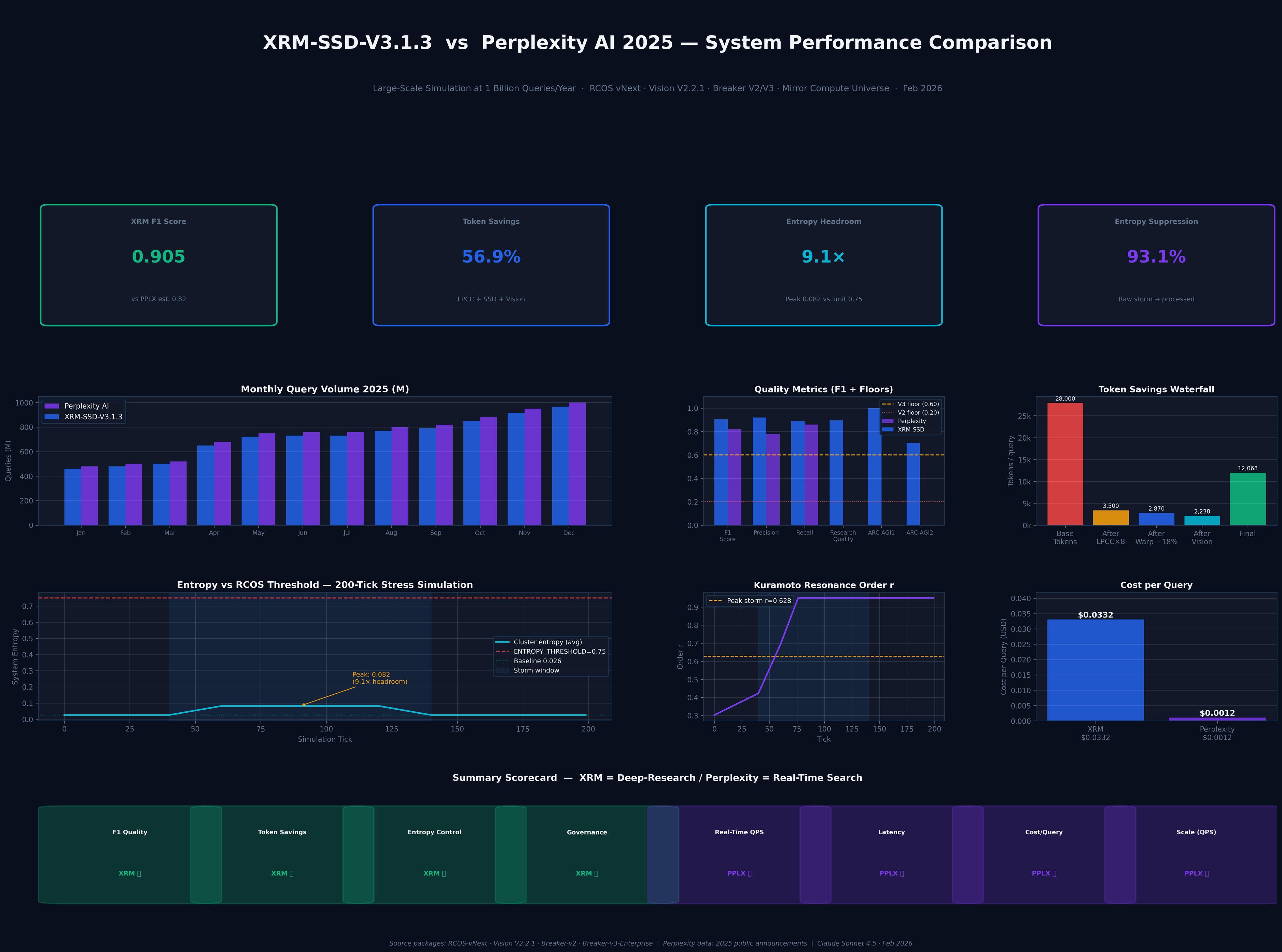
This chart provides a detailed comparative analysis of the system performance of XRM-SSD-V3.1.3 simulating Perplexity AI 2025. The core definition of the chart is: XRM is positioned as "Deep-Research," while Perplexity is positioned as "Real-Time Search."

Below is a Chinese explanation of the key data in the chart:

1. Core Performance Indicators (KPIs)

The four main boxes at the top of the page showcase the key advantages of the XRM system:

XRM F1 Score (0.905): Represents its excellent performance in the accuracy and completeness of information retrieval and generation, surpassing PPLX (Perplexity)'s 0.82.

Token Savings (56.9%): Significantly reduces unnecessary computational overhead through efficient algorithms.

Entropy Headroom (9.1x): Indicates the system's extremely high stability when processing complex and chaotic information, with 9.1 times the headroom before reaching the entropy threshold.

Entropy Suppression (93.1%): Represents the system's ability to effectively filter out noise and refine raw data into useful information.

2. Monthly Query Volume Comparison in 2025 The left-hand bar chart shows the query processing trends of both systems throughout 2025.

Perplexity AI (purple): Shows a stable growth trend, from approximately 400 million queries in January to nearly 1 billion queries (1,000M) in December.

XRM-SSD-V3.1.3 (blue): Its processing volume consistently follows Perplexity, although the total volume is slightly lower, it also grows from around 400 million queries to approximately 900 million queries by the end of the year. This reflects that both are in a period of large-scale growth in 2025.

3. Cost and Efficiency Analysis

The two charts on the right explain the significant differences in their business models:

Cost per Query:

XRM ($0.0332): Because it focuses on "deep research," it requires more computing resources to ensure high-quality output, resulting in higher costs.

Perplexity ($0.0012): Because it focuses on "real-time search," it emphasizes speed and low cost, resulting in extremely low unit prices.

Token Savings Waterfall Chart: Shows how XRM significantly reduces the originally high token consumption through different processing stages (such as LPDC+SSD, Warp, Vision, etc.).

4. Summary Scorecard

The bottom area visually summarizes the competitive advantages of both companies:

XRM's Winning Areas: F1 Quality, Token Savings, Entropy Control (System Stability), Governance.

Perplexity (PPLX) Winning Areas: Real-Time QPS, Latency, Cost/Query, Scale.

Conclusion: This report clearly defines the market segmentation of the two: XRM performs better for tasks requiring extremely high accuracy, in-depth analysis, and system stability; Perplexity is the preferred choice for daily information retrieval that requires extreme speed, low cost, and large scale.
#Scale #XRM #Perplexity