Home
1
Hot News
2
Computing
3
Token Economics4
https://www.dollarchip.com.tw/ Dollarchip Technology Inc.
Dollarchip Technology Inc. 台北市中山區松江路289號4樓-6
If the Terminal-Bench 2.1 numbers in this chart hold roughly true over the next two years, and if Fable 5 / Opus 4.8's token costs see almost no improvement, then the problem becomes very serious.The current gap from your chart is:Model Score Input / 1M Output / 1M Relative to GLM-5.3 OutputGLM-5.3       88.2       $1.40            $4.40    1 ×Fable 5         88.0       $10               $50       11.4×V4-Pro 0813 87.9       $0.435          $0.87    0.20×Opus4.8       85.0       $5                 $25       5.7×GLM-5.2       81.0       $1.40            $4.40     1×In other words, Fable 5 has nearly the same score, but its output cost is 11.4× that of GLM-5.3. Opus 4.8 is even 3.2 points lower, yet still costs 5.7× more.This isn't just a "pricing issue"—it gradually becomes an Inference Economics problem.Phase 1: Enterprises shift to "cost per task"If Fable/Opus only improve intelligence over the next two years without reducing reasoning tokens, output tokens, or inference cost, companies will stop looking at:"Which model has the higher benchmark score?"and start asking:"Which model costs the least to complete the same task?"This trend is already emerging. Studies show that cheaper-labeled reasoning models can sometimes have higher per-task costs because thinking-token consumption varies dramatically.Thus, the real KPI becomes:Cost / solved tasknot:$/1M tokensPhase 2: Fable 5 / Opus 4.8 will be forced to cut pricesSuppose two years from now:· Fable 5 = $10 / $50 — still unchanged· Competitors gradually drop to: $1 / $4Then Fable's output premium becomes:12.5×If intelligence is only 5–10% ahead, that premium is very hard to sustain.In fact, the market in 2026 is already showing intense pricing pressure: OpenAI recently slashed prices on several models, and Chinese models continue to push costs down.More extreme: DeepSeek V4-Flash has already pushed input/output to $0.14 / $0.28 per 1M tokens.So the real point worth noting in your chart isn't 88.2 vs 88.0.It's:88.2 @ $4.40 vs 88.0 @ $50That is a very dangerous economics ratio.Phase 3: The model market starts to "stratify"I think the most likely outcome in two years isn't Fable/Opus disappearing, but the market splitting into:Tier 1 — Ultra-cheap / high-volumeGLM / DeepSeek / Qwen / open-weight models→ Bulk routine work→ Agent background tasks→ Coding sub-tasks→ Summarization→ Classification→ RoutingTier 2 — Premium reasoningFable / Opus / GPT-class→ Truly hard reasoning→ High-value coding→ Research→ Critical decisionsIn other words:Cheap models become the workforce.Premium models become the specialists.This is actually more likely than "cheap models completely replace Opus."Phase 4: The biggest threat is actually the "Router"This is highly relevant to what you're doing with XRM Brain-X / router_service.Suppose a business has 100 tasks:100 tasks│├── 70 simple│       └── GLM / DeepSeek / cheap model│├── 25 medium│       └── mid-tier model│└── 5 extremely difficult         └── Fable / OpusThere's no reason for the business to send:100/100 requests → OpusInstead, it becomes:95/100 → cheap models5/100 → premium modelThis directly reduces Opus/Fable's token volume.So the real competition isn't:"Who has the strongest model?"It's gradually becoming:"Who can route tasks to a good-enough model at the lowest cost?"This is precisely the value of intelligent routing.Phase 5: Worst-case scenario if nothing improves in two yearsAssume by 2028:Fable· Benchmark: 88 → 92· But: $10 / $50 → $10 / $50Competitors· Benchmark: 88 → 91· Price: $1.4 / $4.4 → $0.5 / $2Then Fable's problem isn't "performance lag."It's:Performance advantage / Cost disadvantagebecoming an extremely poor ratio.Enterprises will ask:"Why should I pay 10–25× the inference cost for only a few percentage points of benchmark improvement?"This creates enormous pricing pressure.Phase 6: Opus's situation is somewhat differentOpus 4.8 at:85 @ 25is in a more dangerous position than Fable, because in your chart:GLM-5.3 = 88.2already has:Higher performance + Lower costIf this benchmark holds across different workloads, prompts, batches, and concurrency levels, Opus's commercial positioning must change.It may survive only on:· Higher reliability· Stronger agent capability· Better coding· Longer context· Lower hallucination· Enterprise security· SLA· Tool-use· Ecosystemto maintain its premium.Phase 7: The most important shift — Tokens themselves may become an "obsolete KPI"I think this is especially important for your XRM Brain-XThe future cost formula will look closer to:C_task = T_input·P_i + T_output·P_o + T_reasoning·P_r + C_memory + C_routing + C_retryrather than:C = Tokens × PriceBecause for the same 1M tokens:Model A might complete it in one passModel B might do:· reasoning· tool call· retry· correction· second reasoning· finaland end up spending 3–5× more tokens.Research already shows that thinking-token consumption can drastically alter actual task cost.Phase 8: An important signal for XRM Brain-XIf Fast/Slow Cascade + uncertainty router can do:          Then it's not just "model selection."It's doing:Cost-aware intelligence allocationFor example:· 95% of tasks use $1–4/M token models· 5% of tasks use $25–50/M token modelsIf accuracy remains essentially unchanged, enterprises won't see:"XRM is 20% faster."They'll see:"The total inference bill for the same AI workload dropped 60–90%."That business value is far greater than a benchmark +2%.---My two-year judgmentIf Fable 5 / Opus 4.8 really can't improve token economics over two years:Most likely:Premium → Specialized Premiumrather than outright disappearance.Medium-term:Cheap models capture massive volumeAfter that:Router / orchestration layer decides who gets premium inferenceFinally:Models themselves gradually commoditize. What truly holds value is: "How much intelligence is used per task, on which model, when to upgrade, when to stop reasoning."The market is already moving in this direction: token prices continue to drop rapidly on one side, while frontier reasoning still commands a high premium. A 2026 pricing study even estimated that budget/mid-tier models are seeing price declines faster than traditional Moore's Law, while flagship reasoning models show significantly slower price drops.It's more like showing a potential industry inflection point:88.2 points at $4.40/M may be closer to the future economic model of AI infrastructure than 88.0 points at $50/M.This is also why, if XRM Brain-X can unify routing, KV/context management, early-exit, verification, and model selection into a cost-aware orchestration layer, its value may not come from "building another 90-point model," but from helping enterprises buy 5–10× less expensive inference. https://www.dollarchip.com.tw/hot_538351.html Token Economics 2026-08-15 2027-08-15
Dollarchip Technology Inc. 台北市中山區松江路289號4樓-6 https://www.dollarchip.com.tw/hot_538351.html
https://schema.org/EventMovedOnline https://schema.org/OfflineEventAttendanceMode
2026-08-15 http://schema.org/InStock TWD 0 https://www.dollarchip.com.tw/hot_538351.html

Links:https://fortune.com/2026/08/13/anthropic-said-in-talks-to-bu ...
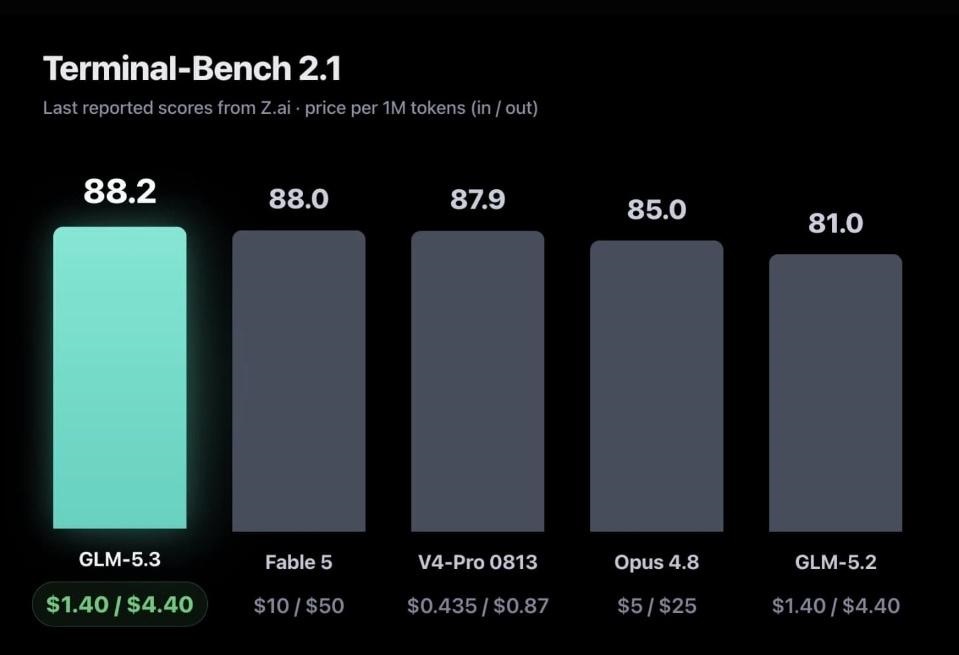


If the Terminal-Bench 2.1 numbers in this chart hold roughly true over the next two years, and if Fable 5 / Opus 4.8's token costs see almost no improvement, then the problem becomes very serious.

The current gap from your chart is:
Model Score Input / 1M Output / 1M Relative to GLM-5.3 Output
GLM-5.3       88.2       $1.40            $4.40    1 ×
Fable 5         88.0       $10               $50       11.4×
V4-Pro 0813 87.9       $0.435          $0.87    0.20×
Opus4.8       85.0       $5                 $25       5.7×
GLM-5.2       81.0       $1.40            $4.40     1×

In other words, Fable 5 has nearly the same score, but its output cost is 11.4× that of GLM-5.3. Opus 4.8 is even 3.2 points lower, yet still costs 5.7× more.
This isn't just a "pricing issue"—it gradually becomes an Inference Economics problem.
Phase 1: Enterprises shift to "cost per task"
If Fable/Opus only improve intelligence over the next two years without reducing reasoning tokens, output tokens, or inference cost, companies will stop looking at:
"Which model has the higher benchmark score?"
and start asking:
"Which model costs the least to complete the same task?"
This trend is already emerging. Studies show that cheaper-labeled reasoning models can sometimes have higher per-task costs because thinking-token consumption varies dramatically.

Thus, the real KPI becomes:
Cost / solved task
not:
$/1M tokens

Phase 2: Fable 5 / Opus 4.8 will be forced to cut prices
Suppose two years from now:
· Fable 5 = $10 / $50 — still unchanged
· Competitors gradually drop to: $1 / $4

Then Fable's output premium becomes:
12.5×
If intelligence is only 5–10% ahead, that premium is very hard to sustain.

In fact, the market in 2026 is already showing intense pricing pressure: OpenAI recently slashed prices on several models, and Chinese models continue to push costs down.
More extreme: DeepSeek V4-Flash has already pushed input/output to $0.14 / $0.28 per 1M tokens.
So the real point worth noting in your chart isn't 88.2 vs 88.0.
It's:
88.2 @ $4.40 vs 88.0 @ $50
That is a very dangerous economics ratio.


Phase 3: The model market starts to "stratify"

I think the most likely outcome in two years isn't Fable/Opus disappearing, but the market splitting into:
Tier 1 — Ultra-cheap / high-volume

GLM / DeepSeek / Qwen / open-weight models
→ Bulk routine work
→ Agent background tasks
→ Coding sub-tasks
→ Summarization
→ Classification
→ Routing

Tier 2 — Premium reasoning
Fable / Opus / GPT-class
→ Truly hard reasoning
→ High-value coding
→ Research
→ Critical decisions

In other words:
Cheap models become the workforce.
Premium models become the specialists.

This is actually more likely than "cheap models completely replace Opus."
Phase 4: The biggest threat is actually the "Router"

This is highly relevant to what you're doing with XRM Brain-X / router_service.
Suppose a business has 100 tasks:
100 tasks

├── 70 simple
│       └── GLM / DeepSeek / cheap model

├── 25 medium
│       └── mid-tier model

└── 5 extremely difficult
         └── Fable / Opus

There's no reason for the business to send:
100/100 requests → Opus
Instead, it becomes:
95/100 → cheap models
5/100 → premium model
This directly reduces Opus/Fable's token volume.

So the real competition isn't:
"Who has the strongest model?"
It's gradually becoming:
"Who can route tasks to a good-enough model at the lowest cost?"
This is precisely the value of intelligent routing.
Phase 5: Worst-case scenario if nothing improves in two years
Assume by 2028:
Fable
· Benchmark: 88 → 92
· But: $10 / $50 → $10 / $50
Competitors
· Benchmark: 88 → 91
· Price: $1.4 / $4.4 → $0.5 / $2
Then Fable's problem isn't "performance lag."
It's:
Performance advantage / Cost disadvantage
becoming an extremely poor ratio.
Enterprises will ask:
"Why should I pay 10–25× the inference cost for only a few percentage points of benchmark improvement?"
This creates enormous pricing pressure.
Phase 6: Opus's situation is somewhat different
Opus 4.8 at:
85 @ 25
is in a more dangerous position than Fable, because in your chart:
GLM-5.3 = 88.2
already has:
Higher performance + Lower cost
If this benchmark holds across different workloads, prompts, batches, and concurrency levels, Opus's commercial positioning must change.

It may survive only on:
· Higher reliability
· Stronger agent capability
· Better coding
· Longer context
· Lower hallucination
· Enterprise security
· SLA
· Tool-use
· Ecosystem
to maintain its premium.

Phase 7: The most important shift — Tokens themselves may become an "obsolete KPI"
I think this is especially important for your XRM Brain-X

The future cost formula will look closer to:
C_task = T_input·P_i + T_output·P_o + T_reasoning·P_r + C_memory + C_routing + C_retry
rather than:
C = Tokens × Price

Because for the same 1M tokens:
Model A might complete it in one pass
Model B might do:
· reasoning
· tool call
· retry
· correction
· second reasoning
· final
and end up spending 3–5× more tokens.
Research already shows that thinking-token consumption can drastically alter actual task cost.

Phase 8: An important signal for XRM Brain-X
If Fast/Slow Cascade + uncertainty router can do:
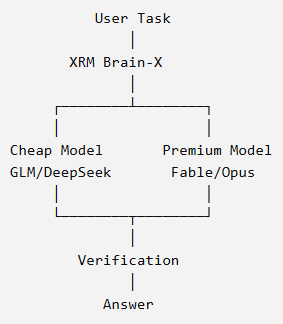
         

Then it's not just "model selection."
It's doing:
Cost-aware intelligence allocation
For example:
· 95% of tasks use $1–4/M token models
· 5% of tasks use $25–50/M token models
If accuracy remains essentially unchanged, enterprises won't see:
"XRM is 20% faster."
They'll see:
"The total inference bill for the same AI workload dropped 60–90%."
That business value is far greater than a benchmark +2%.
---
My two-year judgment

If Fable 5 / Opus 4.8 really can't improve token economics over two years:
Most likely:
Premium → Specialized Premium
rather than outright disappearance.
Medium-term:
Cheap models capture massive volume
After that:
Router / orchestration layer decides who gets premium inference

Finally:
Models themselves gradually commoditize. What truly holds value is: "How much intelligence is used per task, on which model, when to upgrade, when to stop reasoning."
The market is already moving in this direction: token prices continue to drop rapidly on one side, while frontier reasoning still commands a high premium. A 2026 pricing study even estimated that budget/mid-tier models are seeing price declines faster than traditional Moore's Law, while flagship reasoning models show significantly slower price drops.
It's more like showing a potential industry inflection point:
88.2 points at $4.40/M may be closer to the future economic model of AI infrastructure than 88.0 points at $50/M.
This is also why, if XRM Brain-X can unify routing, KV/context management, early-exit, verification, and model selection into a cost-aware orchestration layer, its value may not come from "building another 90-point model," but from helping enterprises buy 5–10× less expensive inference.