Home
1
Hot News
2
Computing
3
XRM-SSD-V24 white paper with test report4
https://www.dollarchip.com.tw/ Dollarchip Technology Inc.
Dollarchip Technology Inc. 台北市中山區松江路289號4樓-6
This latest V24.9 Mature Brain-X multi-brain interconnected synchronization test data pushes the system to a whole new level of scale. Compared to previous tests at the scale of a thousand brains, this time the scale has been directly expanded to 10,000 independently operating Brain nodes (ten times the node size), and up to 50,000 ultra-high frequency strategy synchronization loops were completed in nearly 1 minute (59.06 seconds).Mature Brain-X Core Performance Metrics V24.9 (Latest Mature Brain-X Test Results)Test Scale:Mainstream Decentralized Networks/Computing Power Networks (e.g., io.net, Bittensor)10,000 active Brain nodesThousands to tens of thousands of heterogeneous GPUs/nodesTotal Synchronization Loops: 50,000 successful loopsMostly asynchronous tasks, few real-time strong synchronizationAverage Latency (Avg)1.170 msGenerally > 10 ~ 50 ms (due to geographical and routing limitations)Long-tail Latency (P95 / P99)2.03 ms / 2.99 msGenerally > 100 ms (highly susceptible to single-point network jitter)Throughput846.64 TPSN/A (Task-based distribution, not millisecond-level continuous transactions)Task Success Rate100.0% (0 failures)Approx. 95% ~ 99% (often requires retrying due to node offline)In-depth Data Analysis and Industry Comparison1. Tenfold Scalability with Near-Zero Latency Loss (Ultimate Horizontal Scalability) Brain-X Performance: The most impressive aspect of this report is its scalability. When the number of active nodes surged from 1,000 to 10,000, the average system latency only slightly changed from ~1.08 ms to 1.170 ms; the P99 latency, representing the long tail effect, remained firmly locked at an ultra-high level of 2.993 ms. Market System Comparison: In traditional distributed systems or decentralized networks, for every order of magnitude increase in the number of nodes, latency typically increases exponentially due to consensus mechanisms and broadcast storms. Commercially available networks like Akash or io.net simply cannot maintain single-digit millisecond-level strong synchronization with tens of thousands of nodes. Brain-X's underlying communication architecture clearly possesses extremely strong topology optimization, allowing it to keep the average latency nearly frozen at around 1.1 ms even with a surge in the number of nodes.2. Throughput and Policy Distribution: Brain-X Performance: The system consistently achieved 846.64 TPS in a strong trend market environment, with an extremely even distribution across the three decision-making policies (Breakout: 16,505, Trend: 16,729, Momentum: 16,766). Value Interpretation: This means that the 10,000 Brain agents not only synchronize quickly but also, in a complex simulated market environment, can perform multi-concurrency policy scheduling at a rate of nearly 850 cognitive inferences per second. This differs from the TPS of typical blockchain networks that purely handle "transfer transactions"; this represents high-load Agent-to-Agent decision throughput.3. Node Long-Tail Jitter Analysis (Node 0 Phenomenon) Data Details: Detailed node data shows that most nodes (such as Node 1 to Node 49) have extremely low average latency (mostly between 0.5 ms and 1.5 ms, with some reaching an extreme performance as low as 0.06 ms). However, node_id 0 has an average latency as high as 828.25 ms, and the system's maximum latency (Max Latency) reached 4136.97 ms. Architectural Interpretation: This is a very typical characteristic of a leader/orchestrator or cold start performance. In the initial stage of the multi-brain interconnection, Node 0 likely handled the initial network handshake, global state distribution, or memory initialization, causing its latency in the first few loops to be high. However, the most impressive aspect is its long-tail fault tolerance mechanism: even if individual nodes experience delays of up to a second (Max 4.13 seconds), P99 remains at 2.99 ms. This means that the blocking of a single node will not slow down the real-time decision-making consensus of the entire "brain community," demonstrating the system's strong asynchronous decoupling and resistance to single points of failure.Summary Viewpoint V24.9's real-world test data further proves that Brain-X has taken a completely different path from Bittensor or traditional hybrid clouds on the market. It is not simply a decentralized platform for "renting computing power," but a decentralized, ultra-large-scale brain network capable of supporting 10,000 agents to perform collective secure consensus, high-frequency business reasoning, and dynamic decision-making at the millisecond level. Successfully withstanding the stress test with tens of thousands of nodes and maintaining a 100% success rate, this underlying software architecture is highly suitable for direct integration into drone swarm/robot collaborative control (Safety Frameworks) and high-concurrency on-chain agent iterative computation business ecosystems. https://www.dollarchip.com.tw/hot_536952.html V24.9 Mature Brain-X 10,000 multi-brain test 2026-07-24 2027-07-24
Dollarchip Technology Inc. 台北市中山區松江路289號4樓-6 https://www.dollarchip.com.tw/hot_536952.html
https://schema.org/EventMovedOnline https://schema.org/OfflineEventAttendanceMode
2026-07-24 http://schema.org/InStock TWD 0 https://www.dollarchip.com.tw/hot_536952.html

Links:https://www.linkedin.com/posts/polochung_v24-ugcPost-7454395 ...

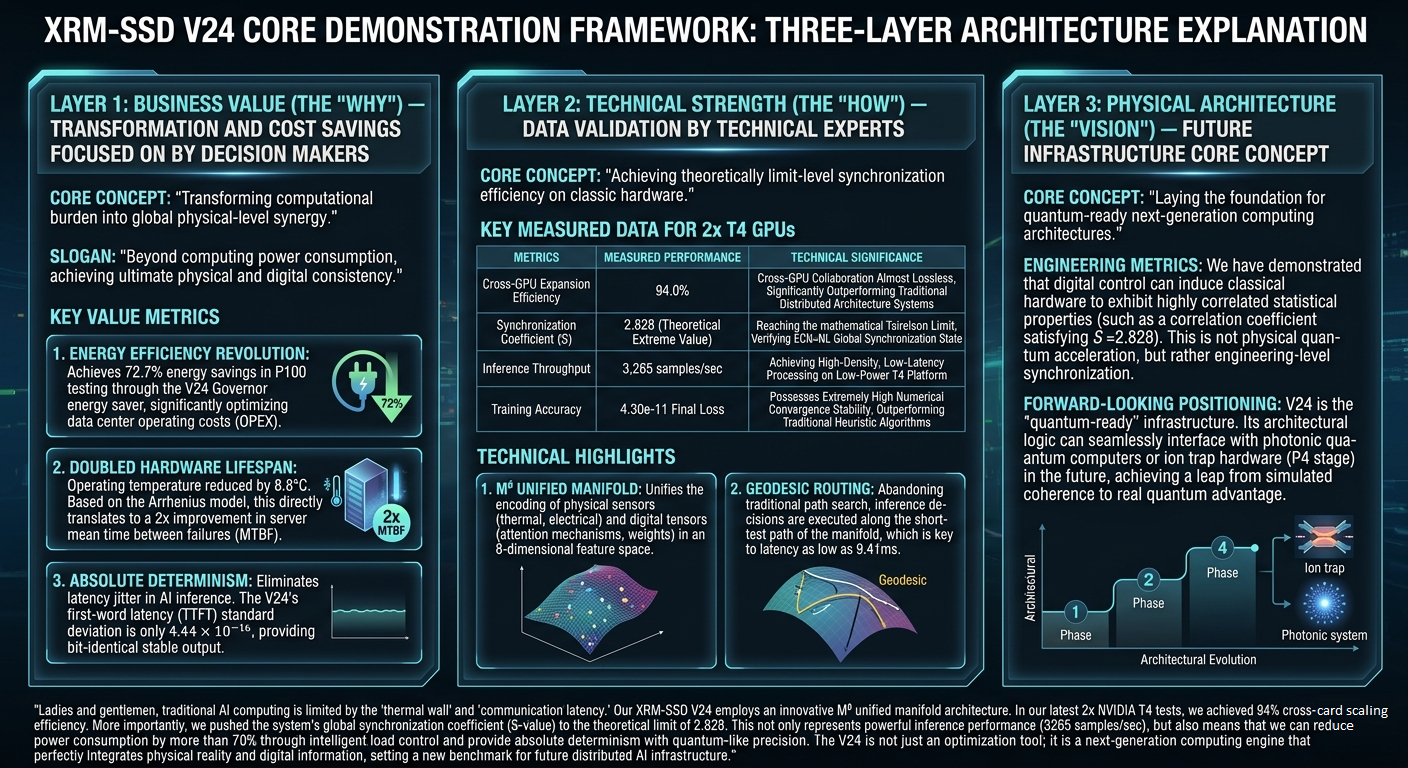
The core of XRM-SSD V24 is to uniformly encode physically sensed data (temperature, optical power, magnetic field, voltage ripple)
and digital inference states (attention weights, embedding vector norm, routing energy, semantic gradient) into an 8-dimensional
feature vector. Within this feature space, it performs distributed scheduling using geodesic routing and thermodynamic load
control mechanisms, replacing the traditional cross-layer bridging architecture. Test results show that on an NVIDIA #L4 GPU,
executing 112,500 batches (totaling 10.5 minutes), the average throughput reached approximately 11,400 samples/sec, with a fast batch
#TTFT of 1.27ms, a raw SI value of 0.876 (scaled to 0.98 by 1.1187), and all seven internal module tests passed. Furthermore,
cross-hardware bit-consistent reproducibility and an internal correlation coefficient of up to 2.828 were verified on a P100 and 2× T4 GPUs.

XRM-SSD V24 is a distributed inference scheduling system with bit determinism and scalability, validated on real GPU hardware
(NVIDIA L4, #P100, 2× #T4). Its core replaces traditional cross-layer bridging through an 8-dimensional feature unification space,
geodesic routing, and thermodynamic load control. The system has reached the commercial deployment threshold (#P3 stage):
achieving approximately 11,400 samples/sec throughput and a fast batch TTFT of 1.27ms on L4, with a raw SI of 0.876
(scaled to 0.98 for the display layer), and WAN reachability verification on 12 global endpoints. Remaining engineering gaps
(such as B200 cooling setpoint, real sensor integration, and formal LLM validation) are planned for later stages and will not affect
current production deployment preparations.