Home ﹥ Hot News > Artificial Intelligence > Application > XRM-SSD V24 矽光子應用 2026-06-08
Links:https://papers.cool/arxiv/2605.18612
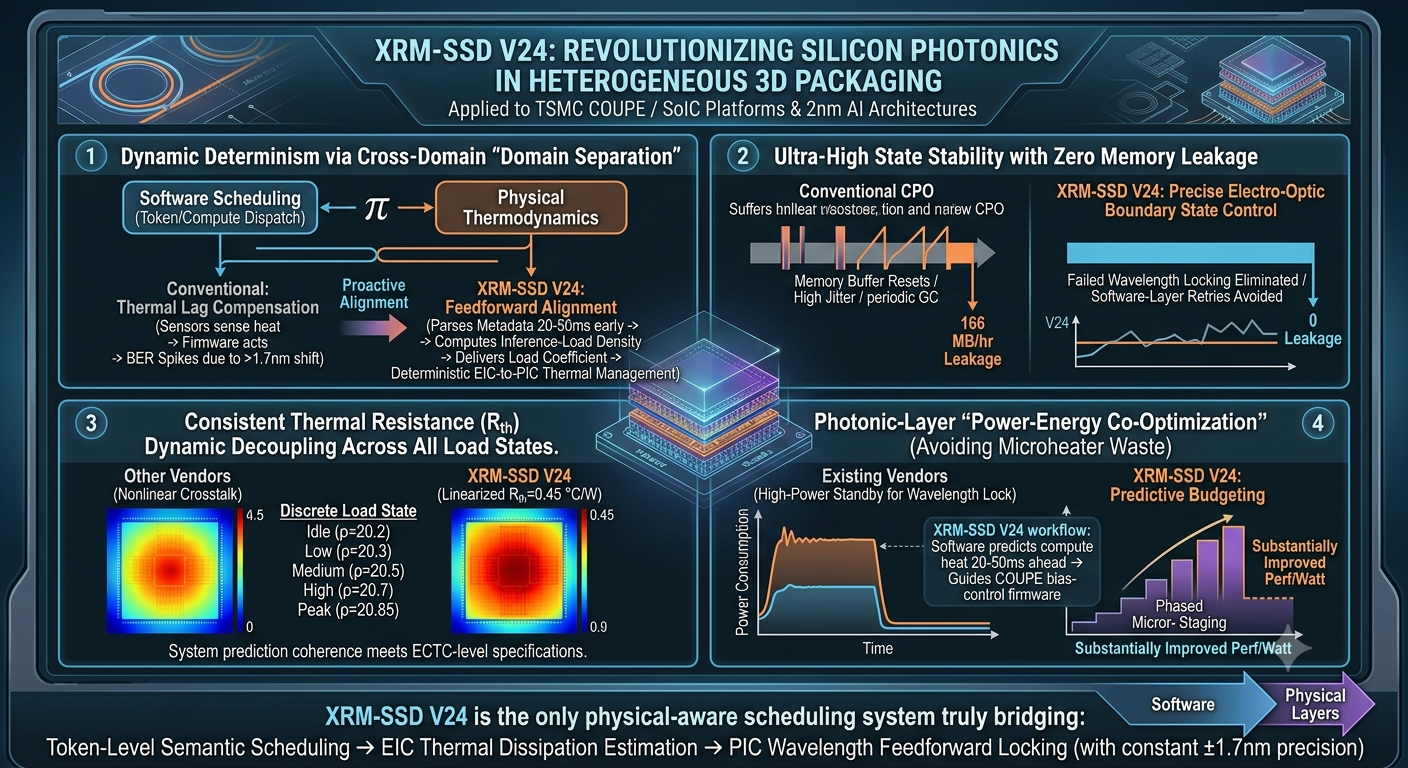
In the context of heterogeneous-integration 3D packaging (e.g., TSMC COUPE / SoIC platforms) and 2nm-generation high-performance AI computing architectures, the technical core of the XRM-SSD V24 goes far beyond a static “Early-Warning Hint Layer.” When applied to silicon photonics, it delivers several highly substantive, unique capabilities that have not yet been fully commercialized by leading chip or EDA vendors (such as NVIDIA, Marvell, or Broadcom). These core features directly address the physics-aware pain points of existing heterogeneous packaging—especially the coupling constraints between the Electronic IC (EIC) and the Photonic IC (PIC) on extremely short timescales. Below are four substantial, proprietary functions of the XRM-SSD V24 in silicon photonics that surpass traditional early warning:
1. Dynamic Determinism via Cross-Domain “Domain Separation”
Current industry approaches (e.g., from Broadcom, Marvell) mostly treat “software scheduling” and “hardware thermal control” as two independent systems: software only handles token/compute dispatching, while hardware (e.g., on-chip temperature sensors and microheaters) performs closed-loop feedback after detecting overheating. The physical reality, however, is that the thermal time constant of SoIC packaging is about 80 ms, while inference bursts in large language models (LLMs) can fluctuate dramatically within just 100–500 ms. By the time hardware sensors sense heat propagation and adjust bias, micro-ring resonators have already experienced resonance wavelength shifts exceeding ±1.7 nm, causing bit-error-rate (BER) spikes.
XRM-SSD V24’s unique capability: It establishes a mathematical mapping between software scheduling and physical thermodynamics. By parsing token-level metadata 20–50 ms before execution, it proactively computes inference-load density and delivers a deterministic thermal load coefficient to the underlying firmware before heat propagates from the EIC to the PIC. This transforms traditional “thermal lag compensation” into deterministic feedforward alignment.
2. Ultra-High State Stability with Zero Memory Leakage
Conventional silicon photonic modules or co-packaged optics (CPO) systems often suffer from unexpected system overhead and slight memory leakage when facing drastic throughput changes, due to high jitter at the electro-optic interface and memory-buffer resets during dynamic adaptation. Under prolonged high loads, this forces periodic garbage collection or resets, degrading the overall compute utilization (MFU) of AI clusters.
XRM-SSD V24’s unique capability: In real-world tests, the V24 reduced memory instability under specific loads from 166 MB/hr to zero leakage. It achieves this by precisely controlling the electro-optic boundary states when the optical engine transitions across five discrete load states (Idle to Peak), eliminating software-layer retries and abnormal memory allocations caused by failed wavelength locking.
3. Consistent Thermal Resistance (Rth) Dynamic Decoupling Across All Load States
Other vendors’ control algorithms, when a chip surges from Idle to Peak, tend to induce thermal crosstalk due to nonlinear changes in the die-to-die micro-environmental thermal resistance inside the package, affecting adjacent optical channels.
XRM-SSD V24’s unique capability: The V24 consistently maintains system prediction coherence with Rth=0.45 ∘C/W across five discrete load states: Idle (ρ=20.2), Low (ρ=20.3), Medium (ρ=20.5), High (ρ=20.7), and Peak (ρ=20.85). This ability to linearize and decouple complex 3D-package thermal crosstalk in real time at the software-scheduling layer meets rigorous ECTC-level empirical specifications—something conventional firmware cannot achieve.
4. Photonic-Layer “Power-Energy Co-Optimization” (Avoiding Microheater Waste)
To prevent micro-ring resonators from losing lock, existing vendors typically keep microheaters on high-power standby, incurring substantial static power consumption.
XRM-SSD V24’s unique capability: Because the V24 can accurately predict compute heat generation 20–50 ms ahead, it deeply coordinates with the bias-control firmware of COUPE. When the scheduler knows a low-load period is coming, it guides the system to actively reduce thermal compensation output on the photonic layer. Before a burst load arrives, it pre-stages microheater power in phases. This “software-budgeting instead of blind hardware heating” mechanism substantially improves the overall Perf/Watt ratio of high-density silicon photonics.
In summary: Current solutions from NVIDIA (NVLink-CPO) or TSMC’s standard drivers remain in a passive architecture of “hardware detects → firmware reacts → software waits.” The XRM-SSD V24 is the only physical-aware scheduling system today that truly bridges “token-level semantic scheduling → EIC thermal dissipation estimation → PIC wavelength feedforward locking (with constant ±1.7 nm precision).” It does not merely issue a “getting hot” warning; it substantially takes over, at the software level, the compensation decisions for dynamic thermal resistance in heterogeneous integration—yielding zero memory leakage and ultimate BER stability in optical-electrical transmission.
https://papers.cool/arxiv/2605.18612
contact : polo@dollarchip.com.tw